
リバースエンジニアリングとは、完成品を分解・解析してその仕組みや構造を理解し、設計思想や製造方法を明らかにするプロセスです。技術開発や互換性の確保において重要な役割を果たす一方で、知的財産権との境界線で法的リスクが生じることもあります。このセクションでは、その基本的な定義と国際的に認められやすい正当な目的を英語で明確に伝える方法を解説します。
リバースエンジニアリングとは何か、そしてその正当な目的を英語で定義する
リバースエンジニアリングのプロジェクトをグローバルなチームで進める際、また関連する法的な議論に参加する際には、その活動の本質と法的な正当性を正確に英語で説明できることが不可欠です。まずは基本概念と法的位置づけから押さえましょう。
そもそもリバースエンジニアリングは合法か?英語で説明する基本概念
法的なグレーゾーンとして捉えられがちですが、特定の条件下では合法とされる行為です。英語で説明する際には、「リバースエンジニアリングそのもの」と、「その結果を用いて行う行為」を分けて考えることがポイントです。
まず、基本的な定義を英語で簡潔に述べるフレーズを覚えましょう。
- “Reverse engineering is the process of analyzing a finished product to understand its design, architecture, or functionality.” (リバースエンジニアリングとは、完成品を分析してその設計、構造、機能を理解するプロセスです。)
- “It involves deconstructing an object to reveal its underlying principles.” (それは対象を分解し、その基本原理を明らかにすることを含みます。)
法的位置づけについては、次のように説明できます。「In many jurisdictions, reverse engineering itself is not inherently illegal.」 (多くの法域では、リバースエンジニアリングそのものは本質的に違法ではありません。) この後に、重要な条件を付け加えます。「However, its legality heavily depends on the purpose, the methods used, and how the derived information is applied.」 (しかし、その合法性は目的、使用された方法、および得られた情報がどのように適用されるかに大きく依存します。)
特許や著作権で保護された要素をそのままコピーして製品を作る行為は、リバースエンジニアリングの結果を用いたとしても、ほとんどの場合、権利侵害とみなされます。
正当な目的と不当な目的を区別するために使う英語表現
活動の正当性を主張するためには、国際的に認められやすい「正当な目的」を英語で明確に示す必要があります。
- Interoperability (相互運用性の確保): “To achieve interoperability with independently created programs or devices.” (独自に作成されたプログラムやデバイスとの相互運用性を実現するため。)
- Compatibility Verification (互換性の検証): “To verify compatibility and ensure our product works correctly with existing systems.” (互換性を検証し、自社製品が既存システムで正しく動作することを確認するため。)
- Education and Research (教育・研究目的): “For educational purposes or academic research to understand technological principles.” (技術的原理を理解するための教育目的または学術研究のため。)
- Security Testing (セキュリティテスト): “To identify and fix security vulnerabilities, enhancing the safety of digital ecosystems.” (セキュリティ上の脆弱性を特定して修正し、デジタルエコシステムの安全性を高めるため。)
- Repair and Maintenance (修理・保守): “To diagnose issues and create replacement parts for repair when original parts are unavailable.” (オリジナル部品が入手不能な場合に、問題を診断し修理用の代替部品を作成するため。)
一方、不当な目的と見なされやすいものは、「to create a substantially similar or copycat product for commercial gain without authorization」 (許可なく商業的利益のために実質的に類似した、または模倣製品を作成すること) や、「to circumvent effective technological protection measures for infringement」 (権利侵害のために効果的な技術的保護手段を回避すること) などです。
プロジェクト開始時に目的と枠組みをチームで共有する英語の一例
実際のプロジェクトでは、キックオフの段階で活動の範囲と目的を文書化し、全関係者で認識を合わせることがリスク管理上、極めて重要です。以下のようなメールや会議での発言が参考になります。
件名: Clarification on the Scope of the [Project Name] Reverse Engineering Analysis
本文:
“Hello team,
As we begin the analysis phase of Project [X], I want to clearly outline the permitted scope of our reverse engineering activities to ensure full compliance.
Primary Objective: Our analysis is strictly for the purpose of achieving interoperability between our new software module and the widely-used [Generic System Name] platform. The goal is to understand necessary data formats and communication protocols, not to replicate any protected code or creative expressions.
Boundaries:
1. We will only analyze publicly available or legally acquired instances of the system.
2. All findings will be documented for the sole purpose of designing our independent interface.
3. No proprietary code, algorithms, or trade secrets will be copied or incorporated into our final product.
Please direct any questions regarding this scope to the legal department before proceeding with deep technical analysis.
Best regards,
[Your Name/Project Lead]”
口頭での説明では、次のように簡潔に伝えることができます。「Just to be clear, we’re doing this to figure out how to make our product talk to theirs, not to copy how their product thinks. Our deliverable is a clean-room design based on the functional specs we deduce.」 (明確にしておきますが、私たちは彼らの製品の考え方をコピーするのではなく、自社製品を彼らの製品と連携させる方法を理解するためにこれを行っています。成果物は、私たちが推測した機能仕様に基づくクリーンルーム設計です。)
このような事前の明確なコミュニケーションは、チームの方向性を統一するだけでなく、万一法的な問い合わせがあった場合にも、誠実な意図を証明する材料となります。
解析手法とプロセスを英語で説明し、透明性を確保する
リバースエンジニアリングの活動内容を明確に伝えるには、具体的な解析手法とその実施プロセスを英語で正確に説明できることが必要です。この透明性が、知的財権の侵害リスクを下げ、正当な目的での活動であることを示す証拠となります。ここでは、主要な解析手法の英語表現と、そのプロセスを文書化する際の実践的なフレーズを紹介します。
「ブラックボックス解析」と「ホワイトボックス解析」の違いを英語で伝える
解析のアプローチは大きく二つに分けられます。外部からの観察に留める「ブラックボックス解析」と、内部構造に立ち入る「ホワイトボックス解析」です。この違いを英語で明確に説明することで、解析の深さと範囲を相手に正確に伝えられます。
法的リスクを考慮し、まずは非破壊的なブラックボックス解析から始めるのが一般的です。この段階で目的が達成できるかどうかを確認し、必要最小限の範囲で解析を進める姿勢を示すことが重要です。
| 解析手法 | 英語での表現 | 説明と主な活動例 |
|---|---|---|
| ブラックボックス解析 (Black-box Analysis) | Analyzing a system solely based on its inputs and outputs without knowledge of its internal workings. | 製品を分解せず、外部から機能をテスト・観察します。例えば、特定の操作に対する応答を記録する「機能分析」や、通信プロトコルを観測する「プロトコル解析」が該当します。 |
| ホワイトボックス解析 (White-box Analysis) | Analyzing a system with full access to its internal structure, design, and implementation. | 製品の物理的な分解や、ソフトウェアのソースコード・機械語レベルの解析を行います。回路のトレースや、ファームウェアの逆アセンブルなど、内部に直接アクセスする手法を含みます。 |
これらの手法を説明する際には、次のような定型表現が役立ちます。
- ブラックボックス解析の実施: “We conducted a black-box functional analysis to understand the device’s behavior without disassembly.” (分解せずに装置の挙動を理解するため、ブラックボックスの機能分析を行った。)
- ホワイトボックス解析への移行理由: “As the black-box analysis was insufficient, we proceeded with a limited white-box analysis of the mechanical components for interoperability assessment.” (ブラックボックス解析では不十分だったため、相互運用性評価のために機械部品に限定したホワイトボックス解析に進んだ。)
物理的分解からソフトウェア解析まで、具体的な手法を英語でどう表現するか
解析手法は対象によってさらに細分化されます。物理製品に対する「非破壊検査」と「破壊検査」、そしてソフトウェアに対する様々なレベルの解析について、適切な英語表現を覚えておきましょう。
- 物理的解析 (Physical Analysis)
- 非破壊検査 (Non-destructive Testing/Inspection): “We performed visual inspection and X-ray imaging to examine the internal layout.” (内部レイアウトを調べるため、視覚検査とX線撮影を行った。)
- 破壊検査 (Destructive Analysis): “A destructive cross-sectional analysis was conducted on a sample unit to study the material composition and bonding techniques.” (材料組成と接合技術を研究するため、サンプルユニットに対して破壊的な断面分析を行った。)
- ソフトウェア解析 (Software Analysis)
- 動的解析 (Dynamic Analysis): “The application was run in a controlled sandbox environment to monitor its runtime behavior and network calls.” (アプリケーションを制御されたサンドボックス環境で実行し、その実行時動作とネットワーク呼び出しを監視した。)
- 静的解析 (Static Analysis): “We performed static code analysis on the obtained firmware to identify publicly available algorithms and libraries.” (入手したファームウェアに対して静的コード解析を実施し、公開されているアルゴリズムとライブラリを特定した。)
- 逆アセンブル/逆コンパイル (Disassembly/Decompilation): “The machine code was disassembled for the sole purpose of studying the interoperability with our system.” (当社システムとの相互運用性を研究する唯一の目的で、機械語を逆アセンブルした。)
解析プロセスを文書化し、英語で報告書を作成する際の構成と表現
解析活動の透明性と正当性を証明する最も確実な方法は、詳細な報告書を作成することです。法的紛争が生じた際の証拠としても機能するため、一定の構成に沿って客観的事実を記録します。
報告書の冒頭で、なぜ解析を行ったのかを明確に述べます。ここで正当な目的(相互運用性の確保、互換性製品の開発、セキュリティ研究など)を具体的に記載することが極めて重要です。
- 定型表現: “The purpose of this analysis was to achieve interoperability between our software and the third-party hardware device.” (本分析の目的は、当社ソフトウェアと第三者製ハードウェア装置間の相互運用性を実現することであった。)
- 定型表現: “This study was conducted for the educational and research purpose of understanding common data encryption methods in the industry.” (本調査は、業界における一般的なデータ暗号化方式を理解するという教育・研究目的で実施された。)
前のセクションで学んだ用語を使って、具体的に何を、どのように行ったかを時系列で記録します。使用したツールや環境も可能な限り明記します。
- 定型表現: “The analysis began with non-invasive black-box testing, including functional input/output mapping.” (分析は、機能的な入出力マッピングを含む非侵襲的なブラックボックステストから開始した。)
- 定型表現: “Subsequently, static analysis of the firmware was performed using a commercially available disassembler to identify the calling conventions.” (その後、市販の逆アセンブラを用いてファームウェアの静的解析を行い、呼び出し規約を特定した。)
個々の観察データから、特許や著作権で保護された具体的な表現をコピーするのではなく、そこから抽出された抽象的な「アイデア」や「機能的な原則」を記述します。これが、独自の製品開発に活用できる情報です。
- 定型表現: “The analysis revealed that the device utilizes a polling-based mechanism to check status, rather than an interrupt-driven one.” (分析により、その装置は割り込み駆動型ではなく、ポーリングに基づくメカニズムを使って状態をチェックしていることが明らかになった。)
- 定型表現: “It was observed that data packets are structured in a common header-payload format, consistent with industry standards.” (データパケットは業界標準と一致する、共通のヘッダー・ペイロード形式で構造化されていることが観察された。)
報告書の結論部分で、重要な宣言を加えます。解析対象の特許や著作権を尊重し、具体的な保護表現をコピーしていないことを明確に述べることで、法的立場を強化します。
- 最も重要な定型句: “This report documents the functional principles and ideas derived from the analysis. No protected expression, such as literal source code or patented circuit diagrams, was copied.” (本報告書は、分析から導き出された機能的原理とアイデアを記録したものである。文字通りのソースコードや特許取得済みの回路図といった保護された表現は一切コピーされていない。)
このような体系的な報告書を作成する習慣は、単なる語学力以上に、プロフェッショナルとしての注意深い作業プロセスそのものを示すことになります。手法の選択から文書化まで、一貫して透明性と正当性を意識した英語でのコミュニケーションが、国際的な共同作業や法的な安全を守る礎となります。

知的財産のグレーゾーンを回避する防衛的コミュニケーション術
リバースエンジニアリングを進める上で最も注意が必要なのは、特許権などの知的財産権との境界線です。技術的な好奇心や互換性の追求が、いつの間にか法的なリスクに発展することがあります。このセクションでは、具体的な「侵害」と「正当な分析」の違いを理解し、チーム内や外部と議論する際に使える防衛的な英語フレーズを身につけます。
「特許クレーム」と「アイデア」の違いを理解し、侵害リスクを議論する
まず、法的に保護されるものとされないものを区別することが第一歩です。特許で保護されるのは、特許請求の範囲(claims)に記載された具体的な発明の実施形態です。一方、抽象的なアイデア、自然法則、数学的アルゴリズムそのものは、原則として特許の対象にはなりません。この違いを英語で説明し、リスクを議論する能力が重要です。
- 保護されるもの(Protected): “The specific implementation of the noise reduction algorithm as described in claim 1 of their patent.”(彼らの特許のクレーム1に記載されたノイズ低減アルゴリズムの具体的な実装)
- 保護されないもの(Not Protected): “The general idea of using machine learning for image recognition.”(画像認識に機械学習を使うという一般的なアイデア)
チームミーティングでは、この区別を明確にした上で議論を進めましょう。
- “We need to distinguish between the patented implementation and the underlying scientific principle.”(特許取得済みの実装と、その基礎にある科学原理とを区別する必要があります。)
- “Our analysis focuses on understanding the principle of operation, not replicating the proprietary implementation.”(私たちの分析は、独自の実装を複製するのではなく、動作原理を理解することに焦点を当てています。)
以下のような表現は、意図せず侵害の意図があるかのように受け取られる可能性があります。使用は避けましょう。
- “We figured out how they do it exactly.”(彼らがどうやってやってるか正確に突き止めた。)
独自の実装方法を解明したと宣言している。 - “Let’s copy this part to improve our product.”(この部分をコピーして製品を改良しよう。)
複製の意図を直接示している。 - “Their patented method is the only way to solve this.”(この問題を解決する唯一の方法は彼らの特許取得済み手法だ。)
その手法を使わざるを得ないと認めてしまう。
分析結果を共有する際に使うべき安全な表現と避けるべき危険な表現
解析結果を文書やプレゼンで共有する際は、公開されている情報や一般的なエンジニアリング知識に基づいていることを強調する表現が有効です。これにより、活動の正当性と透明性を伝えることができます。
使うべき安全な表現(推奨)
- “Our observation is based on the publicly documented API behavior.”(私たちの観察は、公開されているAPIの動作仕様に基づいています。)
- “We avoided any analysis of the black-box, proprietary modules.”(ブラックボックス化された独自モジュールの分析は一切避けました。)
- “This finding is derived from standard engineering techniques and published research.”(この発見は、標準的なエンジニアリング技術と公開された研究から導き出されています。)
- “The interface was reverse-engineered solely for interoperability purposes.”(そのインターフェースは、互換性確保の目的のみのためにリバースエンジニアリングされました。)
報告書や議事録に記載する一文
“The team’s work was scoped to understand the publicly available specifications, ensuring compliance with relevant intellectual property guidelines.”(チームの作業範囲は、公開されている仕様を理解することに限定され、関連する知的財産ガイドラインへの準拠が確保されました。)
マネージャーや法務部門に懸念点をエスカレーションする英語フレーズ
リスクの可能性を感じた時は、ためらわずに上司や法務部門に相談することが最善の防御策です。その際、具体的な懸念点と、明確化が必要な領域を提案する形で伝えましょう。
まず、どの部分がグレーゾーンなのかを特定します。
- “I have a concern that our approach might be getting close to the patented implementation.”(私たちのアプローチが、特許取得済みの実装に接近しすぎている可能性について懸念があります。)
- “Could we review the non-disclosure agreement related to this component?”(このコンポーネントに関連する秘密保持契約を確認できますか?)
自分たちだけで判断せず、専門家の意見を仰ぐことを提案します。
- “To mitigate any potential risk, I recommend we consult with the legal department.”(潜在的なリスクを軽減するため、法務部門に相談することをお勧めします。)
- “It would be prudent to get a clear opinion on the scope of fair use in this case.”(このケースにおけるフェアユースの範囲について、明確な見解を得ることが賢明でしょう。)
相談後の具体的な行動方針を示します。
- “Pending legal advice, I suggest we pause the analysis of this specific module.”(法務のアドバイスを待つ間、この特定モジュールの分析を一時停止することを提案します。)
- “Let’s schedule a meeting with legal to define the safe boundary for our project.”(プロジェクトの安全な境界を定義するため、法務とのミーティングを設定しましょう。)
- 公開されているマニュアルを参考にして類似機能を作るのは特許侵害になりますか?
-
必ずしも侵害とはなりません。特許は「アイデア」ではなく「具体的な実装方法」を保護します。公開マニュアルに基づいて、独自の実装方法で同じ機能を実現するのであれば、多くの場合問題ありません。ただし、その機能を実現する唯一の方法が特許でカバーされている場合は別です。最終的な判断には特許のクレームを精査し、場合によっては専門家の意見を仰ぐことが必要です。
- 「互換性確保」が常に正当な理由として認められますか?
-
多くの法域で重要な正当化理由の一つとされますが、無条件ではありません。重要なのは、互換性を得るために必要最小限の情報のみを取得していることと、その過程で保護されたコードやアルゴリズムを複製していないことです。単に競合製品を作るためだけの解析は、「正当な目的」とは見なされないリスクがあります。
- チームメンバーが危険な発言をしたら、どう切り返すべきですか?
-
その場で、より安全で正確な表現に言い換えて共有することが効果的です。例えば、「彼らの方法をコピーしよう」という発言に対しては、「私たちは、彼らが解決した問題に対する別のアプローチを探求しています」と訂正し、議論の方向性を修正します。プロジェクトのリスク管理として、定期的にコミュニケーションの在り方についてチームで意識合わせをすることも有効です。
知的財産をめぐるリスクは、無知や不用意な発言から生まれることが少なくありません。技術的な分析と並行して、適切な言葉で境界線を意識したコミュニケーションを取る習慣が、プロジェクトと個人を守る強力な盾となります。

会議とディスカッションで使える実践英語フレーズ集
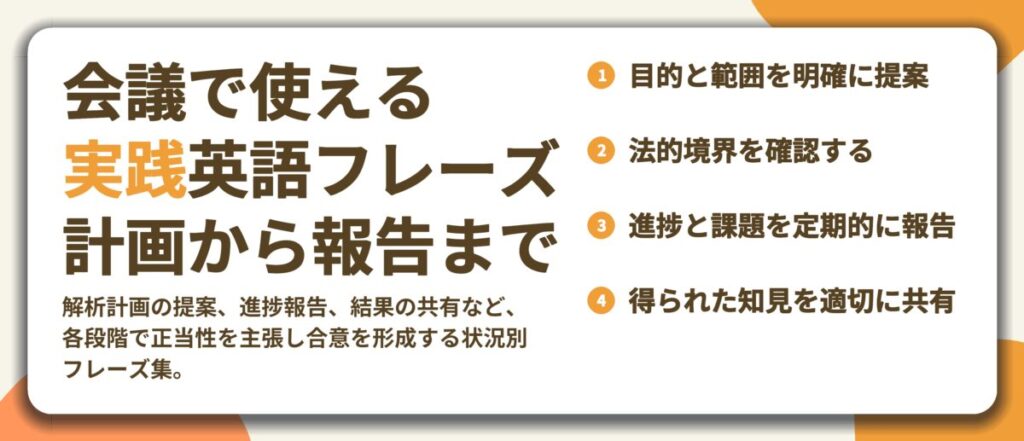
実際のリバースエンジニアリング作業は、一人で完結することは稀です。計画立案から最終報告まで、上司やチームメンバー、場合によっては法務部との綿密なコミュニケーションと合意形成が必要です。このセクションでは、各段階で役立つ具体的な英語フレーズを状況別に紹介します。適切な言葉で意図を明確に伝え、正当性を主張する力を身につけましょう。
解析計画を提案・承認を得る場面
分析を始める前に、その目的と範囲を明確に定義し、関係者の承認を得ることが不可欠です。正当な目的を強調し、法的リスクを軽減する明確な提案が求められます。
- The objective of this teardown analysis is purely for benchmarking our product’s durability.(この分解分析の目的は、自社製品の耐久性のベンチマーキングに限定されています)
- Our analysis will focus on interoperability, not on replicating proprietary algorithms.(我々の分析は独自アルゴリズムの複製ではなく、相互運用性に焦点を当てます)
- We propose to conduct a black-box analysis to understand the user interface flow without disassembling the software.(ソフトウェアを分解せずにユーザーインターフェースの流れを理解するため、ブラックボックス解析の実施を提案します)
- To ensure compliance, we will document each step and avoid any reverse engineering of patented components.(コンプライアンスを確保するため、各ステップを文書化し、特許取得済みコンポーネントのリバースエンジニアリングは避けます)
Manager: I understand you want to analyze the competitor’s device. What’s the specific goal, and how do you plan to stay within legal boundaries?
Engineer: The objective of this teardown analysis is purely for benchmarking our product’s durability. We will compare material choices and assembly techniques. We have a checklist to ensure we do not analyze any components covered by active patents.
中間進捗報告で分析内容を説明する場面
分析途中では、発見した事実を客観的に報告し、それが当初の目的にどう関連するかを示すことが重要です。「観察した」という事実と、そこから導かれる「可能性」を区別して伝えましょう。
- We observed that the competitor uses a standard communication protocol, which we can leverage for compatibility.(競合他社が標準通信プロトコルを使用していることを確認した。これは互換性のために活用できる)
- Our findings suggest that their cooling system is more efficient, but the principle is based on public-domain knowledge.(彼らの冷却システムはより効率的であることが示唆されますが、その原理は公開された知見に基づいています)
- We have identified an area for potential improvement in our design, inspired by their approach to modularity.(彼らのモジュール性へのアプローチに触発され、自社設計の改善余地がある領域を特定しました)
- It is important to note that we have not accessed or analyzed any encrypted firmware or software code.(暗号化されたファームウェアやソフトウェアコードにはアクセスも分析も行っていない点に留意することが重要です)
最終成果を発表し、得られた知見を自社開発にどう活かすかを議論する場面
分析の最終段階では、得られた知見をまとめ、それをどのように合法的かつ建設的に自社の製品開発に応用するかを明確に示す必要があります。ここで曖昧な表現を使うと、意図が誤解されるリスクがあります。
- The learning from this study will be applied to improve our manufacturing process, not to copy the design.(この調査からの知見は、設計をコピーするためではなく、自社の製造プロセスを改善するために応用されます)
- We recommend adopting a similar user-centric approach, but we will develop our own unique implementation.(同様のユーザー中心のアプローチを採用することを推奨しますが、独自の実装を開発します)
- This analysis confirms our hypothesis about market trends and validates the direction of our R&D roadmap.(この分析は市場動向に関する我々の仮説を裏付け、研究開発ロードマップの方向性を検証するものです)
- To avoid any IP issues, we will use these insights as a reference point for brainstorming alternative solutions.(知的財産上の問題を回避するため、これらの知見は代替ソリューションをブレインストーミングするための参考点として使用します)
最終報告では、「コピー(copy)」「複製(replicate)」「模倣(imitate)」といった言葉は極力避け、「改善(improve)」「最適化(optimize)」「インスピレーションを得る(draw inspiration from)」「参考にする(use as a reference)」といった建設的な語彙を選びましょう。これは単なる言葉の綾ではなく、活動の本質的な意図を言語化する行為であり、法的リスク管理の一環です。
これらのフレーズは、会議での発言や報告書の作成にそのまま活用できます。重要なのは、分析活動の各ステップで、その目的と境界線を自ら言葉にして確認し、周囲と共有することです。これにより、技術的な探求と法的・倫理的な規範のバランスを取りながら、価値ある知見を安全に得る道筋が明確になります。

ケーススタディ:架空の製品解析を想定した英語ドキュメント作成演習
これまでに学んだ防衛的表現を、実際の文書作成に落とし込む方法を具体的な演習を通じて身につけましょう。リバースエンジニアリングの現場では、調査の経緯と目的、方法、そして得られた知見を明確に文書化することが、法的なリスクを管理し、正当な成果物として価値を生むために不可欠です。ここでは、互換性調査という正当な目的に基づいた架空のシナリオを設定し、報告書とプレゼンテーションスクリプトを作成します。
シナリオ設定:ある民生用電子機器の互換性調査
あなたの会社では、ある既存の民生用電子機器(例:スマートホームデバイス)と互換性のある新たな周辺機器の開発を検討しています。この周辺機器が、既存機器との通信プロトコルや物理インターフェースを正しく認識し、連携できるかどうかを確認する必要があります。調査の目的は、新製品の開発可能性を探るための技術的互換性の評価であって、オリジナル製品の知的財産を侵害したり、複製したりすることではありません。
この演習では、調査対象の製品は市販されており、あなたは正規ルートで購入しています。また、調査は所有する当該製品1台のみに対して実施し、得られた結果は社内での製品開発判断にのみ使用します。第三者への再配布や、市場への流出は一切想定していません。
解析報告書のアウトラインを英語で作成する
調査結果をまとめるために、チームや上司に提出する正式な内部報告書のアウトラインを作成します。各セクションには、本記事で学んだ安全な表現を積極的に取り入れましょう。
調査目的を明確に示すタイトルと、要約を書きます。
- Title: Compatibility Analysis Report for [Target Device Name] – Assessment for Potential Peripheral Development
- Executive Summary: This report summarizes the findings from a compatibility analysis conducted on the commercially available [Target Device Name]. The objective was to understand the publicly available interface specifications to evaluate the feasibility of developing a compatible peripheral device. The analysis was conducted solely on a legally purchased unit and focused on functional interoperability without disclosing or replicating protected intellectual property.
正当な分析方法であることを強調して記述します。
- Methodology: The analysis employed black-box testing methods, observing input and output behaviors without accessing or analyzing internal proprietary code or algorithms. All tests were performed within the bounds of the device’s intended user operations and documented communication protocols available in the public domain.
得られた技術的知見を、特許クレームとは切り離して記述します。
- Findings & Discussion: The investigation revealed that the device utilizes a standardized communication protocol for data exchange. Based on this observation, it is our technical opinion that developing a peripheral using the same open standard is feasible. It is important to note that this conclusion is based on an analysis of functional behavior and does not constitute an opinion on the validity or scope of any patents that may cover the device’s implementation.
調査の範囲と、次のステップを明確にします。
- Conclusion & Recommendation: The compatibility analysis indicates a promising technical path forward for peripheral development. We recommend proceeding to the next phase, which involves designing our own independent implementation based on the observed public standards. Prior to any commercial development, a formal freedom-to-operate review by the legal department is strongly advised to assess potential patent landscapes.
調査結果をまとめたスライドを英語で説明するスクリプト
報告書の内容をチーム内のミーティングで共有する場面を想定します。プレゼンテーションでは、口頭での説明がより重要です。以下のスクリプト例は、知的財産を尊重しつつ、技術的な核心を伝えるバランスを学ぶのに役立ちます。
“Good morning, everyone. Today, I’ll walk you through our findings on the compatibility analysis for the [Target Device]. Let me start by reiterating the scope of our work. This was an interoperability study, not a design replication effort. Our goal was strictly to assess if we could build a peripheral that works with it, not like it.”
“Moving to the methodology slide. We employed what’s known as black-box testing. In simple terms, we treated the device as a closed system, observing how it responds to various inputs. We did not decompile software or analyze any protected elements. All our observations are based on its external, functional behavior.”
“Here are the key technical observations. The device communicates using a well-documented, industry-standard protocol. This is a significant finding because it means the pathway for interaction is publicly defined. Our analysis of the signal timing and data packet structure aligns with this public specification.”
“To be clear, we are discussing the idea of using a standard protocol, which is not protectable. We are not making any claims about the specific, potentially patented implementation inside the target device. Our proposed path forward is to design our own original circuit and firmware that adheres to the same public standard.”
“In conclusion, from a pure engineering standpoint, developing a compatible peripheral is technically feasible. However, the final green light must come after a thorough patent review by legal. Our next recommended step is to prepare a detailed project proposal for their assessment.”
この演習で重要なのは、調査の「目的」「方法」「結論」の全ての段階で、正当性を言語化することです。報告書でも口頭説明でも、意図を明確に伝える言葉を選ぶ習慣が、プロフェッショナルとしての信頼と安全を築きます。